NARI is proud to be a member of the Remodeling Futures Group at Harvard University’s Joint Center for Housing Studies (JCHS), one of the nation's foremost research institutions dedicated to housing policy and market analysis.
Each year, the Center publishes The State of the Nation's Housing — a definitive report that shapes how policymakers, lenders, and industry leaders understand the U.S. housing market. The 2026 edition was released this month, offering a closer look at the trends and factors influencing the remodeling industry.
Key takeaways include:
Remodeling is Outpacing New Construction
- Homeowner improvement spending reached $376 billion in 2025, nearly matching all new single-family development ($419B).
- Homeowner improvement spending increased by 153% over the past decade, far outpacing new single-family (90%) and multifamily (84%) construction.
- Remodeling now accounts for 41% of total U.S. construction spending, up from 34% in 2015.
An Aging Housing Stock is Sustaining Demand
- The median U.S. owner-occupied home is now 42 years old, up from 33 years in 2010.
- Owners of pre-1940 homes spend 50% more annually on improvements and repairs than those in newer homes.
Aging in Place is a Growing Trend
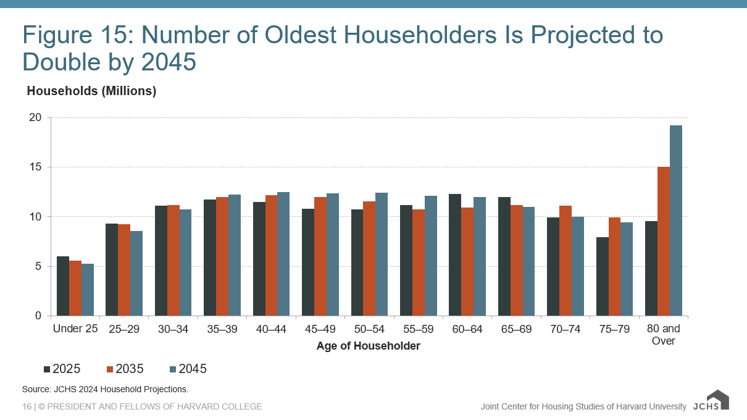
- The 65+ population grew from 48 million to 65 million between 2015 and 2025 and is projected to reach 71 million by 2030.
- In 2024, more than half of professional remodelers were involved in aging-in-place modifications.
Homeowners are Staying Put – Creating an Opportunity for Remodelers
- Existing home sales are near a 30-year low (4.1 million in 2025), as millions of homeowners hold onto pandemic-era mortgage rates.
- Home prices are up 54% since 2020, and the median home now costs nearly five times the median household income — keeping many owners locked in place.
Drivers of Housing Demand Are Weakening
The new report shows that household growth slowed for the third consecutive year in 2025, reflecting reduced household formation among young adults amid weak labor markets, heavy student debt, and intensifying economic uncertainty.
“Many young adults simply cannot afford to form their own households and are instead doubling up or living with family,” said Daniel McCue, senior research associate at the Joint Center for Housing Studies. “For others, deep uncertainty about their financial futures and about the broader economy is causing them to delay major life decisions. This pullback is a clear sign of economic stress that reverberates through housing markets.”
The report documents a record-low residential mobility rate of 11.2 percent in 2024, driven primarily by declining moves among homeowners, who are often “locked in” by below-market mortgage rates. Interstate moves have also fallen, easing population gains in fast-growing states like Texas and Florida and stemming losses in states such as California and Illinois.
Housing demand is further threatened by restricted immigration and increased deportations. ![]() Net international migration fell by half in 2025, and is expected to drop another 75 percent in 2026.
Net international migration fell by half in 2025, and is expected to drop another 75 percent in 2026.
Construction Softens as Vacancies Rise
New housing construction softened again in 2025, as high homebuying costs stifled demand and unsold inventories grew, prompting builders to cut prices, buy down interest rates, and pivot toward smaller, more cost-efficient homes and lots. Multifamily construction remained below recent peaks as markets struggled to absorb a large wave of new deliveries.
“The existing stock of low-rent housing is shrinking rapidly, and private markets are incapable of producing enough deeply affordable units,” said Alexander Hermann, senior research associate at the Center. “The number of units renting for under $1,000 a month in real terms fell by more than 7 million between 2014 and 2024, while higher-rent units surged. Without significant new subsidies and stronger protections for at-risk properties, we risk losing even more of the limited affordable stock that remains.”
Cost Burdens at Record Highs
![]() Renter cost burdens hit a new peak in 2024: 22.7 million renter households (49 percent) spent more than 30 percent of their income on housing, including 12.1 million (26 percent) who spent more than half of their income on housing.
Renter cost burdens hit a new peak in 2024: 22.7 million renter households (49 percent) spent more than 30 percent of their income on housing, including 12.1 million (26 percent) who spent more than half of their income on housing.
Meanwhile, ![]() homeowners face monthly costs near record highs: property taxes rose 31 percent between 2019 and 2025, while average monthly insurance premiums jumped 72 percent, as extreme weather and climate change inflict greater damage to the nation’s housing supply and put tens of millions of homes at significant risk.
homeowners face monthly costs near record highs: property taxes rose 31 percent between 2019 and 2025, while average monthly insurance premiums jumped 72 percent, as extreme weather and climate change inflict greater damage to the nation’s housing supply and put tens of millions of homes at significant risk.
At the same time, sky-high home prices and elevated mortgage rates are keeping many renters from transitioning to homeownership. Home prices have increased 54 percent nationwide since 2020, and in 2025, the median existing single-family sales price was ![]() nearly five times the median household income.
nearly five times the median household income.
Federal Assistance Deeply Inadequate
Federal housing assistance remains profoundly inadequate relative to need, and while recent changes to the Low-Income Housing Tax Credit will help finance additional units over the next decade, funding for vouchers and public housing is not keeping pace, according to the report. In response, states and localities are expanding and innovating their own tools, but private-sector innovations and more robust federal action will be necessary to meaningfully reduce widespread housing challenges.
“Across the country, we see governors, mayors, and local leaders stepping up with creative solutions to expand supply and support vulnerable households,” said Chris Herbert, managing director of the Center. “But these efforts are patchwork and often precariously funded. Only the federal government has the scale and staying power necessary to close the gap between what our housing system produces and what our lowest-income households can afford. Without a more robust national response, we risk deepening inequities and entrenching housing instability for millions.”
Download the report + interactive maps and data