By Andersen Windows and Doors
How do triple-pane windows make a difference?
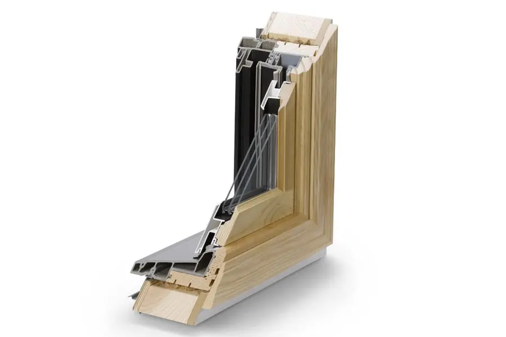
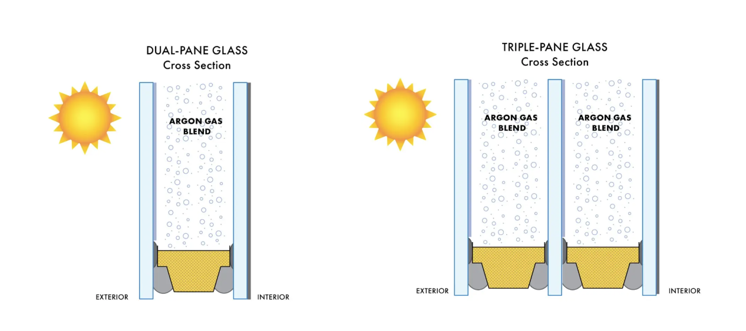
The specific performance benefits of windows with triple-pane glass include:
-
Improved insulation: A window with triple-pane glass will be more insulating than a window with standard dual-pane glass. The additional pane of glass and additional air space, combined with opportunities for multiple Low-E coatings, slow down the transfer of heat.
-
Reduced sound: Windows with triple-pane glass will almost always outperform those with dual-pane glass in terms of sound. This is because they’re thicker. The thickness of the two air spaces and three panes of glass slows down the transmission of sound.
How is thermal performance measured?
The thermal performance of windows and doors is measured with U-Factor values. Looking at a window's U-Factor value will help you compare between manufacturers and understand if the performance will meet standards for various energy-efficient building programs.
It’s important to consider the U-Factor value for the entire window assembly — glass, frame, etc. — when assessing performance. To do this, look for the “whole unit” U-Factor value rather than the “center of glass” U-Factor value. It’s particularly important to look at U-Factor performance when you live in a cold climate because it will help you understand how well the unit will help keep in warm air during the winter. (In a hot climate, Solar Heat Gain Coefficient would be the thermal performance value to evaluate because it gives an indication of how well the unit will help keep the sun’s heat out).
What’s the difference between R-Value and U-Factor?
-
R-Value is a measurement of resistance to energy (or heat) flow, with larger numbers indicating better resistance. In other words, a window’s R-Value is a measurement of how well the window keeps heat from escaping the home, or how insulating the window is. Although both measures relate to thermal performance, it’s most common to see R-Value used to measure wall assemblies and U-Factor to measure window assemblies.
-
U-Factor is the inverse of R-Value. Instead of measuring resistance to heat flow, it measures heat loss, with smaller numbers indicating a slower rate of loss. U-Factor is also the measure used by the National Fenestration Rating Council (NFRC), a nonprofit organization that has established energy performance ratings for windows, doors, and skylights.
Want to understand more about the difference between R-Value and U-Factor values?
How is sound performance measured?
The measures used to evaluate sound performance are sound transmission class (STC) and outdoor-to-indoor transmission class (OITC). A higher value indicates better sound reduction for both STC and OITC. We provide STC and OITC ratings through our own testing — find performance documents.
How do Low-E coatings improve triple-pane glass performance?
The more coatings applied, the better the thermal performance will be. Low-E coatings can be applied to triple-pane glass in various ways. Here’s what you should know:
1. Standard triple-pane glass (one Low-E coating)
Standard triple-pane glass options include one surface with a Low-E coating. These are our standard glass coating options:
-
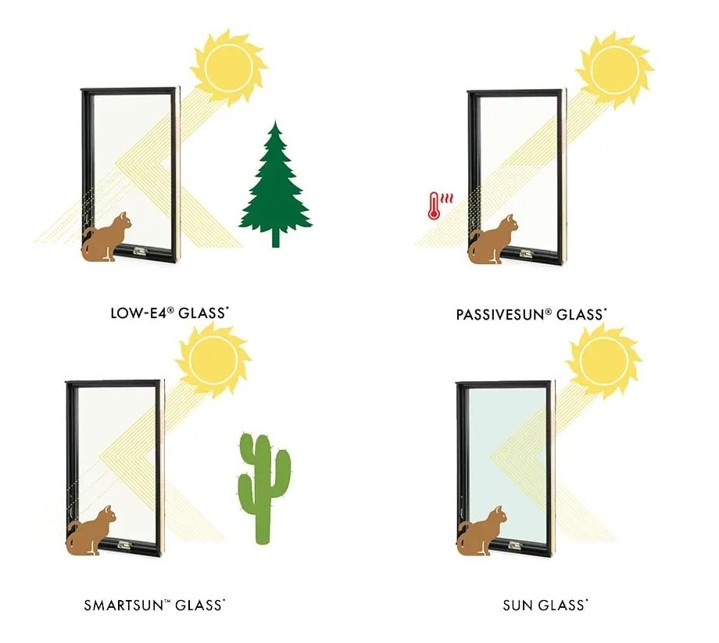
Low-E4® Triple Pane Glass is a great option in most climates because it helps reflect heat in the summer and keep heat inside in the winter, making it ideal in any climate where both heating and cooling costs are incurred. It’s a well-rounded glass option that works in all climates.
-
Low-E4 SmartSun™ Triple Pane Glass gives the benefits of Low-E4 glass while also blocking 95% of harmful UV rays. This makes it a good option in all climates, particularly the sunny West or milder South.
-
Low-E4 PassiveSun® Triple Pane Glass allows the sun to help heat the home in the winter when a low sun angle directs more energy through the glass. It is made for climates where extensive heating is required and is ideally suited to passive homes.
-
Low-E4 Sun Triple Pane Glass is made to help block the sun’s heat and is tinted. Compared to SmartSun glass, its tint is more pronounced, and it’s more effective at blocking the sun. It’s ideally suited for southern climates.
2. Enhanced triple-pane glass (two Low-E coatings)
Enhanced triple-pane glass options include two surfaces with Low-E coatings, which further enhance thermal performance. Here are some combinations to be aware of:
-
Low-E4 Enhanced Triple-Pane Glass has one pane with Low-E4 coating plus an additional Low-E coating on another light of glass. This combination of Low-E coatings helps windows perform well in all seasons while also allowing the sun's warmth to heat the home. It’s a good option in northern climate zones.
-
Low-E4 SmartSun™ Enhanced Triple-Pane Glass has one pane with a SmartSun coating plus an additional Low-E coating on another light of glass. This combination helps keep homes cool in summer and warm in winter, with the added benefit of blocking 95% of harmful UV rays. It’s a good option where there are both heating and cooling bills along with lots of direct sunlight.
-
Low-E4 PassiveSun Enhanced Triple-Pane Glass has one pane with a PassiveSun coating plus an additional Low-E coating on another light of glass. This option helps improve thermal performance while avoiding a lot of tint. This enhanced version of triple-pane glass allows in the most heat from the sun’s waves, so it’s a good option for passive homes or homes designed to handle higher solar heat loads in the northernmost climate zones.
3. Enhanced triple-pane glass with HeatLock® technology (three Low-E coatings)
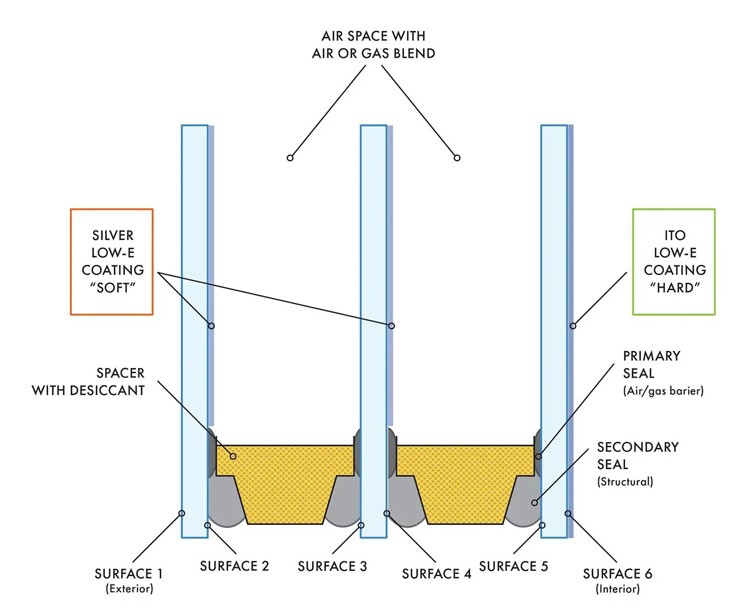
Enhanced triple-pane glass options with HeatLock® technology allow three panes to be coated with a combination of two of our “soft” coatings — Low-E4, SmartSun, Passive Sun, and Sun — and our “hard” coating of HeatLock technology. HeatLock technology helps keep heat from escaping the home. When combined with the right “soft” coatings, it can provide a glass option that’s suited to various climates. Here are three options to be aware of:
-
Low-E4 Enhanced Triple-Pane Glass with HeatLock Technology is ideal for homes where energy use is split more evenly between heating and air conditioning and where there’s an intermediate level of solar heat gain.
-
Low-E4 SmartSun Enhanced Triple-Pane Glass with HeatLock Technology delivers high thermal performance with minimal solar heat gain, making it ideal for a home with lots of direct sun exposure. It’s typically used in southern climates.
-
Low-E4 PassiveSun Enhanced Triple-Pane Glass with HeatLock Technology allows the sun to help heat the home, so it’s best used in a home that’s designed to handle a higher solar heat load. It’s typically used in northern climates.
Are triple-pane windows worth the investment?
Short answer: Yes, in the right location, in the right home, and for the right homeowner — triple-pane windows can be worth it. Here’s what we mean:
-
Northern climate zone: Triple-pane glass is most impactful in northern climate zones where more months are spent with the heat on.
-
High-performing homes: In a home that’s designed to be high-performing, such as a passive house, this type of glass might be the right choice.
-
Comfort and efficiency-minded homeowners: The type of homeowner interested in enjoying higher levels of thermal comfort and noise reduction, without sacrificing views and natural light, is more apt to see the appeal of triple-pane windows.
How expensive are triple-pane windows?
The exact cost will depend on the product line, window type, and any added options. However, it’s true that triple-pane windows typically cost more than standard dual-pane windows. Why?
-
Materials: Triple-pane windows require more materials to make, including some that are more expensive.
-
Time: They also require more time to manufacture. The glass specifically takes longer to produce.
-
Components: With a thicker and heavier piece of glass, stronger components are needed to make the window operate, again contributing to a higher price.
-
Weight: The physical weight of the window is typically 1.5 times that of a standard dual-pane window, which may require more labor or equipment for installation.
Understand more about window and door costs or get specific details you need for budgeting by requesting a quote.
Triple-pane windows and code
If you live in a northern climate, you’ll likely begin to see more reasons to choose this type of glass — here's why:
-
Stricter mandatory codes: Energy codes are becoming more stringent in some places, such as states in the Northeast, like Massachusetts and New York. Some of these states are implementing “stretch code,” which goes beyond base code in pursuit of energy and climate goals.
-
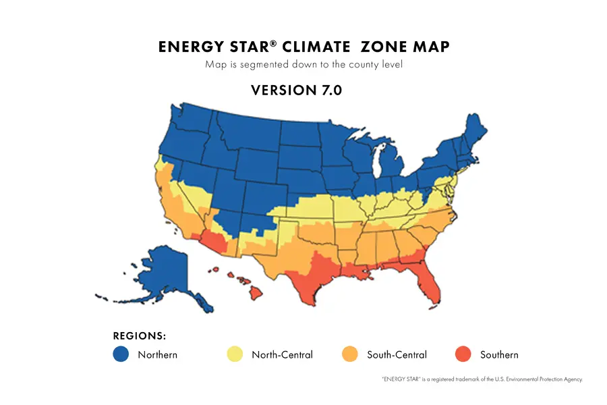
Stricter voluntary codes: ENERGY STAR version 7.0, released at the end of 2023, is generally considered a leading indicator of where mandatory codes will go next. To meet ENERGY STAR performance criteria in the northern climate zone, it’s becoming increasingly necessary to switch from dual-pane glass to triple-pane glass.
Wondering which window and door products will meet ENERGY STAR criteria? Check out our guide to ENERGY STAR version 7.0.