By The Harvard Joint Center for Housing Studies
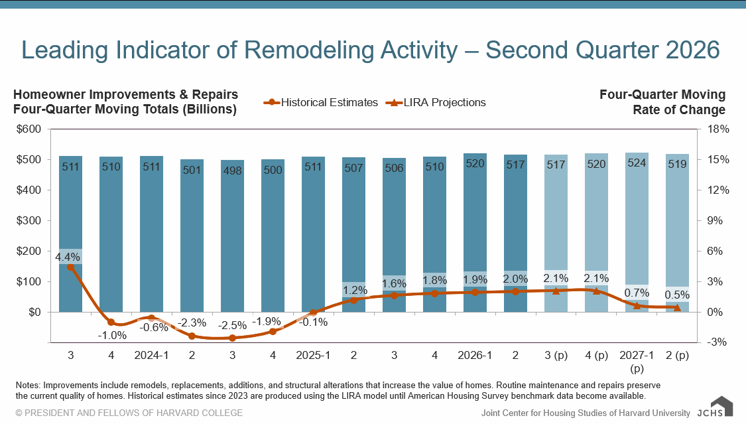
Annual spending on home improvements and repairs is expected to continue losing momentum through mid-2027, according to the latest Leading Indicator of Remodeling Activity (LIRA) from the Remodeling Futures Program at the Joint Center for Housing Studies of Harvard University. Year-over-year growth in renovation and repair spending is expected to slow to just 0.5 percent in the second quarter of 2027.
"Growth in remodeling permitting and retail spending on building products have flattened recently, suggesting that renovation activity is cooling," said Rachel Bogardus Drew, Director of the Remodeling Futures Program at the Center. "Our forecast suggests this will lead to a third straight quarter of decelerating year-over-year growth, with spending projected to be $519 billion through mid-2027."
“Reduced housing starts and broader economic uncertainty are also limiting stronger gains in remodeling spending,” said Chris Herbert, Managing Director of the Center. “Until home sales rebound from current low levels, remodeling expenditures are likely to stay at this pace.”
Column and line chart providing quarterly historical estimates and projections of homeowner improvement and repair spending from 2023-Q3 to 2027-Q2 as four-quarter moving sums and rates of change. Year-over-year spending growth declined from 4.4% in 2023-Q3, softening rapidly down to -1.0% by 2023-Q4. Year-over-year spending declined in 2023-Q4 through 2025-Q1, bottoming out at a rate of -2.5% in 2024-Q3. Annual rates of change turned positive again beginning in 2025-Q2 and are expected to decelerate from 2.1% in 2026-Q3 to 0.5% in 2027-Q2. Annual spending levels are expected to increase from $517 billion in 2026-Q2 to $519 billion in 2027-Q2.
The Leading Indicator of Remodeling Activity (LIRA) provides a short-term outlook of national home improvement and repair spending to owner-occupied homes. The indicator, calculated from the annual rate of change of its components, is designed to project the annualized spending for the current quarter and subsequent four quarters, and is intended to help identify future turning points in the business cycle of the home improvement and repair industry. Originally developed in 2007, the LIRA was re-benchmarked in April 2016 to a broader market measure based on the biennial American Housing Survey (AHS), and was last revised in late 2024 with updated correlations following the release of the 2023 AHS.
The LIRA is released by the Remodeling Futures Program at the Joint Center for Housing Studies of Harvard University approximately three weeks after each quarter’s closing. The next LIRA release date is October 22, 2026.
The Remodeling Futures Program, initiated by the Joint Center for Housing Studies in 1995, is a comprehensive study of the factors influencing the growth and changing characteristics of housing renovation and repair activity in the United States. The Program seeks to produce a better understanding of the home improvement industry and its relationship to the broader residential construction industry.
The Harvard Joint Center for Housing Studies strives to improve equitable access to decent, affordable homes in thriving communities. We conduct rigorous research to advance policy and practice, and we bring together diverse stakeholders to spark new ideas for addressing housing challenges. Through teaching and fellowships, we mentor and inspire the next generation of housing leaders.